
South Korea Kitchen Appliances Market Overview
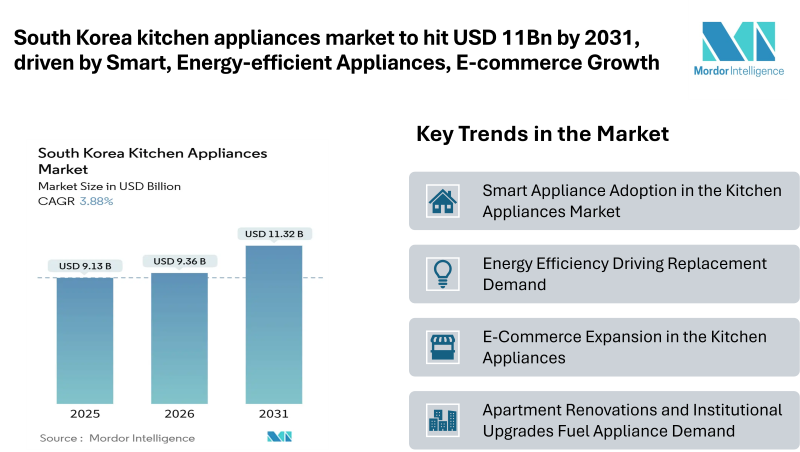
According to Mordor Intelligence, the South Korea kitchen appliances market size is witnessing steady expansion as households and institutions continue to upgrade appliances with connected features and higher energy-efficiency standards. According to industry analysis, the market is expected to increase from USD 9.13 billion in 2025 to USD 9.36 billion in 2026 and reach USD 11.32 billion by 2031, reflecting a CAGR of 3.88%.
Another factor influencing growth is the rapid expansion of online retail platforms. Consumers now expect faster delivery and installation services for large household devices, which has increased the share of digital channels within the industry. These combined factors are helping maintain stable value expansion and shaping the South Korea kitchen appliances market share among leading manufacturers.
Key Growth Drivers in the South Korea Kitchen Appliances Market
Smart Appliance Adoption in the Kitchen Appliances Market
One of the most visible market trends in South Korea is the growing adoption of smart and connected appliances. High broadband penetration and strong 5G connectivity across the country provide a stable foundation for devices that rely on software updates and app-based control. Connected refrigerators, ovens, and dishwashers are becoming common in modern households. Many models now include features such as food recognition, inventory alerts, and recipe assistance. These tools help users manage daily cooking tasks more efficiently and encourage upgrades to premium appliances within the industry. This trend also strengthens the South Korea kitchen appliances market share of manufacturers that build integrated ecosystems where multiple devices communicate with each other through a single application.
Energy Efficiency Driving Replacement Demand
Energy efficiency policies are playing an important role in market growth. Government programs offering rebates for high-efficiency appliances encourage households to replace older products with newer models that meet national energy standards. Appliances such as refrigerators, rice cookers, and dishwashers that carry top efficiency ratings are eligible for financial incentives. These programs reduce the cost burden for buyers and help increase demand for premium models within the market. This policy environment also encourages manufacturers to design appliances with lower energy consumption and improved performance. Over time, these upgrades strengthen the overall value proposition in the industry and support the long-term South Korea kitchen appliances market forecast.
E-Commerce Expansion in the Kitchen Appliances
Another important kitchen appliances market trend is the rapid expansion of online retail channels. South Korea has one of the most developed e-commerce infrastructures, with logistics networks capable of delivering large appliances within short time frames. Major digital platforms now offer same-day or next-day delivery for many household devices. These services have changed how consumers purchase large appliances, shifting more transactions from physical stores to digital platforms. As logistics performance becomes a major factor in customer satisfaction, companies in the kitchen appliances industry are investing heavily in supply chain efficiency and installation services.
Apartment Renovations and Institutional Upgrades Fuel Appliance Demand
Flexible housing designs are allowing residents to reconfigure kitchen layouts without major demolition, boosting demand for modular, built-in appliances that fit new spaces. At the same time, public-sector investments in school kitchens and equipment upgrades are driving institutional replacement cycles, favoring high-throughput dish care and food prep systems that meet safety standards. Expanded School Meal Service Support Centres and national programs for centralized sorting, storage, and distribution create a steady demand for commercial-grade refrigeration and compliance-ready equipment. Cost-sharing provisions under the Act on School Meal Services provide guidance for facility planning and procurement, adding predictability to public kitchen upgrades. These trends support recurring replacement activity in urban households and institutions, reinforcing a value-driven growth path for the South Korea kitchen appliances market.
Check out more details and stay updated with the latest industry trends, including the Japanese version for localized insights: https://www.mordorintelligence.com/ja/industry-reports/south-korea-kitchen-appliances-product-market?utm_source=emailwire
South Korea Kitchen Appliances Market Segmentation
By Product
- Large kitchen appliances such as refrigerators, dishwashers, and cooking equipment
- Small kitchen appliances including rice cookers, air fryers, and compact ovens
By End User
- Residential households
- Commercial establishments such as hotels, restaurants, and institutional kitchens
By Distribution Channel
- B2C retail sales including online and offline channels
- B2B distribution for institutions and commercial buyers
By Geography
- Seoul Capital Area
- Chungcheong Region
- Gangwon Province
- Jeolla Region
- Rest of South Korea
Explore Our Full Library of Home and Property Improvement Research
https://www.mordorintelligence.com/market-analysis/home-property-improvement?utm_source=emailwire
Key Players in the South Korea Kitchen Appliances Industry
- Samsung Electronics Co., Ltd.
- LG Electronics Inc.
- Cuckoo Electronics Co., Ltd.
- Coway Co., Ltd.
- Winia Electronics (Daewoo)
Explore more insights on South Korea kitchen appliances competitive landscape: https://www.mordorintelligence.com/industry-reports/south-korea-kitchen-appliances-product-market/companies?utm_source=emailwire
Conclusion
The outlook for the market remains stable as replacement demand, energy-efficiency initiatives, and digital retail channels continue to influence consumer purchasing behavior. The shift toward connected appliances and higher-value products supports consistent kitchen appliances market growth even in a mature market where most households already own essential devices.
Government incentives for energy-efficient products are expected to encourage further upgrades across residential and commercial segments. At the same time, improvements in logistics infrastructure and e-commerce platforms will continue to strengthen online sales within the market. Overall, the market forecast points toward steady expansion supported by premium replacement cycles, integrated smart-home ecosystems, and efficient distribution networks. These factors will continue to shape the long-term direction of the kitchen appliances industry and maintain a competitive environment among leading manufacturers.
For more insights on South Korea kitchen appliances market, please visit the Mordor Intelligence page: https://www.mordorintelligence.com/industry-reports/south-korea-kitchen-appliances-product-market/?utm_source=emailwire
Industry Related Reports:
GCC Major Home Appliances Market
The GCC major home appliances market reached USD 3.23 billion in 2025 and is estimated at USD 3.83 billion in 2026, with projections indicating it will grow to USD 4.51 billion by 2031, registering a CAGR of 3.32% during 2026–2031. Growth is supported by rising urbanization, increasing disposable income, and strong demand for energy-efficient appliances across residential developments and smart homes in Gulf countries.
Europe Major Home Appliances Market Size
The Europe major home appliances market is valued at USD 56.57 billion in 2025 and is expected to reach USD 57.85 billion in 2026, expanding to USD 64.12 billion by 2031 at a 2.08% CAGR between 2026 and 2031. Market growth is driven by increasing adoption of smart and connected appliances, replacement demand for energy-efficient products, and sustainability regulations encouraging eco-friendly household technologies.
South America Laundry Appliances Market Share
The South America laundry appliances market reached USD 4.83 billion in 2025 and is forecast to grow to USD 5.18 billion in 2026, eventually reaching USD 6.25 billion by 2031, reflecting a CAGR of 3.83% from 2026–2031. Expansion is supported by rising middle-class households, growing penetration of automatic washing machines, and increasing demand for convenient and water-efficient laundry solutions.
About Mordor Intelligence:
Mordor Intelligence is a trusted partner for businesses seeking comprehensive and actionable market intelligence. Our global reach, expert team, and tailored solutions empower organizations and individuals to make informed decisions, navigate complex markets, and achieve their strategic goals.
With a team of over 550 domain experts and on-ground specialists spanning 150+ countries, Mordor Intelligence possesses a unique understanding of the global business landscape. This expertise translates into comprehensive syndicated and custom research reports covering a wide spectrum of industries, including aerospace & defense, agriculture, animal nutrition and wellness, automation, automotive, chemicals & materials, consumer goods & services, electronics, energy & power, financial services, food & beverages, healthcare, hospitality & tourism, information & communications technology, investment opportunities, and logistics.
For any inquiries or to access the full report, please contact:
media@mordorintelligence.com
https://www.mordorintelligence.com/
Mordor Intelligence, 11th Floor, Rajapushpa Summit, Nanakramguda Rd, Financial District, Gachibowli, Hyderabad, Telangana – 500032, India